Prohibited and Restricted Items for Travelers Entering Iran: A Complete Guide
Essential Guide to Prohibited Items for Iran Travelers


Iran welcomes millions of visitors each year with its deep history, vibrant culture, and famous hospitality. To ensure a smooth entry, travelers must understand the customs regulations that govern what can and cannot be brought into the country. Knowing the most common Iran prohibited items before you pack helps protect national security, preserve cultural heritage, and prevent avoidable delays or penalties at the border.
This guide explains which items are fully banned, which are restricted and require permission, and how to handle medicine, electronics, and customs declarations on arrival. Preparing ahead of time is the best way to avoid complications at the airport. If you are planning your trip with SURFIRAN, your travel advisor can also help you review what to pack before departure.
Contents
Quick Checklist: What Not to Bring to Iran
Use this quick checklist as a starting point. The sections below explain each category in more detail. When in doubt, leave the item at home or verify in advance, because rules can change and enforcement can vary.
- Leave behind: alcoholic beverages of any kind
- Leave behind: narcotics and controlled psychotropic substances
- Leave behind: weapons, ammunition, knives, and explosives
- Leave behind: drones, UAVs, and unauthorized satellite internet devices
- Leave behind: media that may conflict with local cultural and moral standards
- Declare or pre-arrange: prescription medicines, especially controlled ones
- Declare or pre-arrange: large amounts of gold, silver, or platinum
- Declare or pre-arrange: pets, plants, seeds, and agricultural materials
Customs Declaration Requirements
According to Iranian customs regulations, all passengers must declare every item they are carrying. This may be done verbally, but if customs officers issue a written declaration form, travelers must complete it accurately.
Any item that is deliberately hidden or not declared may be treated as smuggled property, which is considered a serious legal violation. When you are unsure whether something needs to be declared, it is safer to declare it and ask the customs officer.
How to Declare Items Smoothly
- Keep valuable electronics, jewelry, and professional gear easy to access for inspection.
- Carry receipts or documentation for high-value or specialized equipment.
- Be honest and cooperative; declaring an item is not the same as it being banned.
- If a written form is provided, complete it carefully and keep your copy.
Fully Prohibited Items Entering Iran
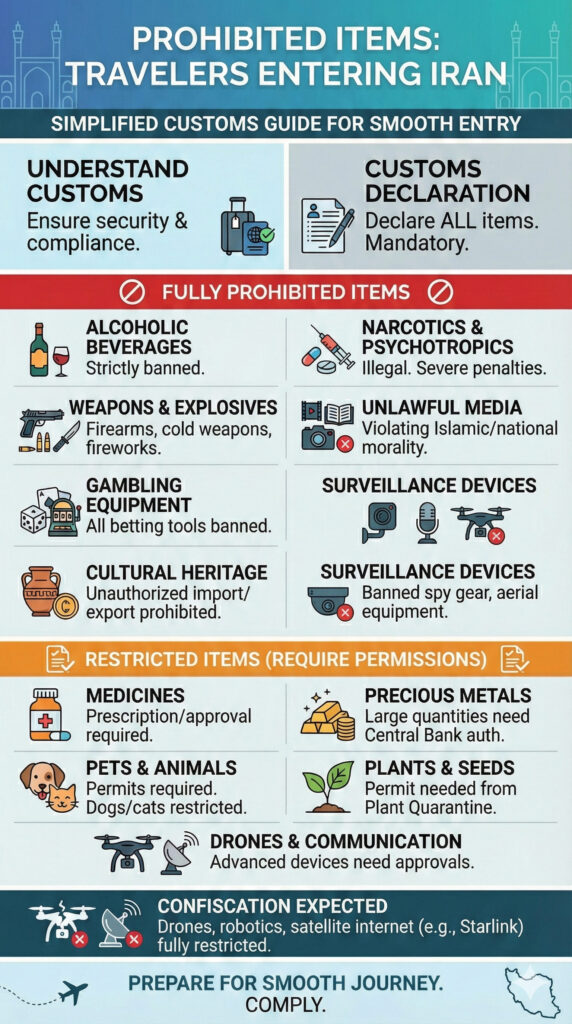
The following categories of items are strictly banned and may not be brought into Iran under any circumstances. These are the core Iran prohibited items every traveler should know before packing.
Alcoholic Beverages
Carrying any alcoholic drink into Iran is strictly prohibited. This applies to all travelers regardless of nationality, and includes duty-free purchases. Do not pack alcohol in checked or carry-on luggage.
Narcotics and Psychotropic Substances
All illegal drugs and controlled psychotropic substances are completely banned and carry severe penalties. Recreational substances that may be legal elsewhere are not permitted in Iran. If you take prescribed medication that contains a controlled ingredient, see the medicine guidance below.
Weapons and Explosives
The import of the following items is fully prohibited:
- Firearms and ammunition
- Knives, daggers, and other cold weapons
- Explosives, fireworks, and pyrotechnic materials
Inappropriate or Unlawful Media
Publications, images, digital files, and films that violate local cultural values or national morality standards are not permitted. Travelers should be mindful that printed materials and digital content may be subject to review.
Gambling Equipment
Any device or tool associated with gambling or betting is prohibited.
Cultural Heritage and Antiquities
Bringing in or taking out antique items, historical artifacts, or objects considered cultural heritage without authorization is strictly forbidden. This is an especially important rule when leaving Iran, so keep receipts for any handicrafts or souvenirs you purchase legitimately.
Surveillance and Espionage Devices
Under Article 122 of the Customs Affairs Law, the following items are banned:
- All types of transmitting devices and related components
- Equipment for aerial photography or videography
- Miniature cameras, covert microphones, and hidden recording tools
- Monitoring and interception systems, both wired and wireless
- Encryption devices or tools with intelligence or espionage capabilities
The import of specialized telecommunication or electronic devices that may be misused for monitoring or surveillance—especially commercial-grade or advanced models—is strictly prohibited.
Electronics and Drone Caution
Standard personal electronics such as a smartphone, laptop, tablet, camera, and e-reader are generally fine for tourists to bring for personal use. The caution applies to advanced, professional, or specialized equipment that could be classified as restricted or prohibited.
Drones and UAVs
Drones, quadcopters, and other unmanned aerial vehicles are highly sensitive. They typically require approval from Iran’s Civil Aviation Organization and the Ministry of Communications, and unauthorized devices may be confiscated at the border. For most travelers, the simplest and safest choice is to leave drones at home.
Satellite Internet and Communication Devices
Advanced communication equipment and unauthorized satellite internet devices, such as Starlink terminals, remain fully restricted and cannot be brought into Iran. Travelers should expect such items to be confiscated if carried. For everyday connectivity, a local SIM card is widely available after arrival.
Restricted Items Requiring Official Permissions
Some items may be allowed only with relevant medical, environmental, or governmental authorization. These are not outright banned, but they require paperwork or advance approval.
Medicines and Prescriptions
Certain medications, including those containing codeine, sedatives, or controlled ingredients, may require:
- A valid medical prescription
- Supporting medical documentation
- In some cases, prior approval
As a cautious general practice, keep medicines in their original packaging, carry a copy of the prescription (ideally in English), bring only quantities reasonable for your trip, and check with the relevant authorities or your embassy before departure if you are unsure about a specific drug. This guidance is general and not a substitute for official confirmation, since rules on individual substances can change.
Precious Metals
Large quantities of gold, silver, or platinum beyond personal-use allowances require authorization from the Central Bank of Iran. Ordinary personal jewelry that you wear or carry for your own use is normally not a concern, but commercial quantities are treated differently.
Pets and Animals
Importing pets or wildlife requires veterinary and environmental permits. Entry of dogs and cats is generally restricted unless special permits are obtained, so arrange documentation well in advance if you intend to travel with an animal.
Plants, Seeds, and Agricultural Materials
Plants, seeds, and saplings may only be brought in with a permit from the Plant Quarantine Organization.
Cultural Sensitivity for Travelers
Beyond the official customs list, packing with cultural awareness helps your trip go smoothly. Iran is a country with conservative dress codes and social norms, and being respectful of local values is part of being a considerate guest.
- Pack modest clothing; a headscarf is generally expected for women in public spaces.
- Avoid items, symbols, or printed materials that could be considered politically or culturally sensitive.
- When unsure about clothing or etiquette, ask your guide or tour operator for current local advice.
Traveling with a trusted operator makes this easier. Browse the available Iran tours or request a tailor-made itinerary so a local team can advise you on packing, dress, and entry formalities before you arrive.
Airport Arrival Tips
A little preparation makes passing through Iran airport customs far less stressful. Keep these practical tips in mind as you land:
- Have your passport, visa, and any required permits organized and within reach.
- Pack any items you may need to declare where they are easy to show.
- Stay calm and cooperative; answer questions clearly and honestly.
- Do not attempt to hide restricted items—undeclared goods can be treated as smuggling.
- If an officer asks to inspect a device or bag, allow it and keep documentation handy.
- If you are unsure about an item, ask before passing through rather than after.
Frequently Asked Questions
Can I bring alcohol into Iran?
No. Carrying any alcoholic beverage into Iran is strictly prohibited for all travelers, including duty-free purchases. Leave alcohol out of both your checked and carry-on luggage.
Can I bring my prescription medication?
Often yes, but some medicines—especially those with codeine, sedatives, or other controlled ingredients—may require a prescription, supporting documents, or prior approval. Keep medicines in their original packaging with a copy of your prescription, and verify any specific drug before departure, as rules can change.
Are drones allowed in Iran?
Drones and UAVs are highly restricted and generally require approval from Iran’s Civil Aviation Organization and the Ministry of Communications. Unauthorized drones may be confiscated, so most travelers should leave them at home.
Can I bring a laptop and camera as a tourist?
Standard personal electronics like a laptop, smartphone, and consumer camera are generally fine for personal use. The restrictions focus on professional, specialized, or surveillance-capable equipment, as well as drones and unauthorized satellite communication devices.
What happens if I do not declare a restricted item?
An item that is deliberately hidden or not declared may be treated as smuggled property, which is a serious legal violation. When in doubt, declare the item and ask the customs officer.
Where can I confirm the latest rules?
Customs regulations may be updated periodically. Confirm current rules with the Iran Customs Administration, your departure airport or airline, your embassy, and your tour operator before you travel.
Important Reminder: Verify Before You Travel
Customs regulations may be updated periodically. For the most accurate and current information, travelers should:
- Review official guidance from the Iran Customs Administration
- Confirm rules with their departure airport or airline
- Consult their tour operator or travel advisor before travel
Final Notes
Understanding and following Iran’s customs rules ensures a respectful, safe, and efficient entry process. Reviewing these guidelines on Iran prohibited items before your trip helps avoid unnecessary issues and allows you to begin your journey with confidence.
Staying informed is the best first step toward a smooth arrival in Iran. When you are ready to plan, SURFIRAN can help you organize your trip and answer practical questions about traveling to Iran.