Holy Defense Museum in Tehran: Exhibits and Visitor Guide


The National Museum of the Islamic Revolution and Holy Defense in Tehran explores the 1979 Iranian Revolution and the Iran–Iraq War of 1980–1988. Its galleries combine historical photographs, personal objects, reconstructions and multimedia displays. The museum stands in the Abbas Abad cultural district near Tabiat Bridge.

The term Holy Defense reflects an established Iranian commemorative description of the war. The conflict began with Iraq’s invasion of Iran on 22 September 1980 and lasted almost eight years. For a historical overview beyond the museum’s own interpretation, see Encyclopaedia Iranica’s account of the Iran–Iraq War.
The war continues to shape Iranian public memory. Films, books, poetry, memorials and family accounts have explored the experiences of soldiers and civilians, as well as the long-term consequences of the conflict.
Across Iran, monuments, named streets and annual commemorations recall people who died during the war. Museums provide another way to encounter these memories through documents, objects and curated displays. As with any historical museum, its exhibits represent a particular institutional perspective.

Contents
Understanding the Museum’s Historical Perspective
The museum opened to visitors in the early 2010s. It presents the revolution and the subsequent war through themed exhibition spaces, drawing on historical materials and immersive techniques rather than a conventional chronological display alone.
Its landscaped grounds in Abbas Abad include memorial spaces, a lake and buildings associated with the museum complex. The site is close to Taleghani Park and other cultural attractions in northern-central Tehran. The UN Tourism listing identifies the museum and its location, but a special free-admission announcement from 2025 should not be treated as a permanent ticket policy.
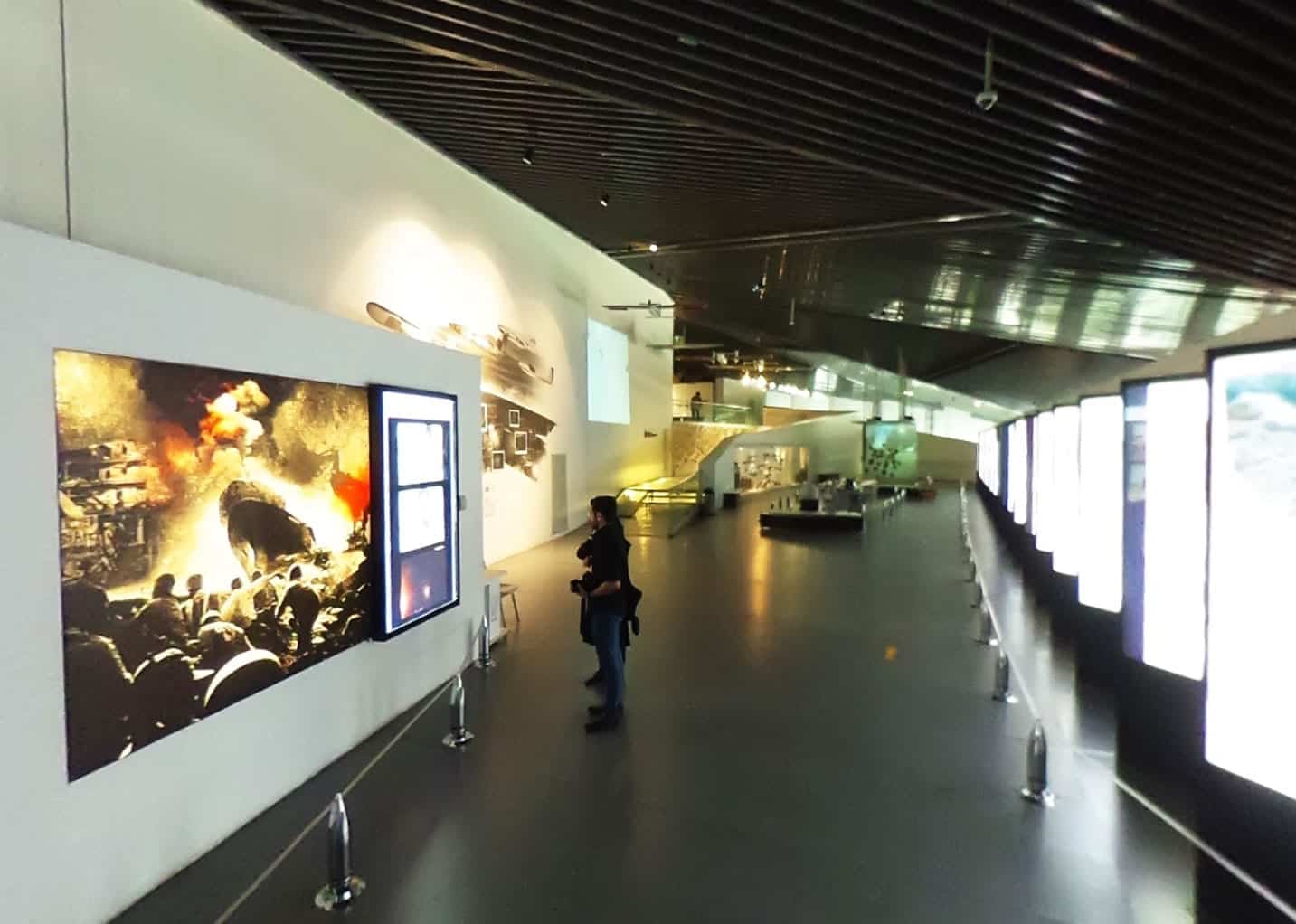
The exhibitions use photographs, personal belongings, film and reconstructed environments to communicate different aspects of the war. Gallery arrangements and access may change, so descriptions of individual rooms should be treated as a guide rather than a guarantee of what is on display on a particular day.
One recurring subject is Khorramshahr, the port city in Khuzestan Province that experienced intense fighting in 1980. The museum uses reconstructions and visual material to introduce visitors to the city’s wartime history.
Khorramshahr in the Museum’s Exhibitions

Khorramshahr was captured by Iraqi forces during the opening phase of the war in 1980. Iranian forces regained control of the city in May 1982. The events remain prominent in historical accounts and in Iranian commemorative culture.
Descriptions of Khorramshahr often emphasise the destruction of homes, displacement of residents and difficult conditions faced by civilians. The city’s experience is an important part of understanding the human cost of the wider conflict.
The return of Khorramshahr to Iranian control in 1982 became a major milestone in the war. It is remembered annually in Iran, and the museum presents this episode through displays focused on the city and its people.
Reconstructed streets and interiors invite visitors to consider everyday life during the fighting. Such installations can make historical events easier to visualise, although they are interpretive exhibits rather than exact reproductions of every original scene.
Personal objects and photographs also draw attention to volunteers, conscripts, families and civilians affected by the war. Their stories help place military events within a broader social history.
The museum’s commemorative approach is part of the subject itself. Visitors interested in a fuller historical picture may wish to compare its presentations with independent scholarship and personal accounts from different communities.

Photographs, Objects and Multimedia Displays
Photographic displays and installations document people and places associated with the conflict. Visitors may encounter portraits, wartime objects and artistic arrangements that reflect the museum’s focus on remembrance.
Published visitor descriptions have mentioned multilingual interpretation, but language services can change. Ask the museum directly whether English-language guides or audio materials are available for your planned visit.
Video projections, sound, lighting and reconstructed settings are used to tell parts of the story. These techniques create a more immersive experience than a display of documents alone.
The installations are designed to convey atmosphere and memory. They are best understood as museum interpretations supported by selected historical materials, not as a substitute for primary documents or independent research.
The complex is also of interest for its contemporary architecture and landscaped setting. It can be combined with other cultural stops described in our Tehran travel guide.
For travellers interested in modern Iranian history, the museum offers insight into how the revolution and the Iran–Iraq War are presented in public remembrance. Allow enough time to read exhibit information and consider the context of what is shown.
Planning a Visit to the Museum
Haqqani Metro Station is a commonly used access point for the Abbas Abad area. Check current metro routes and local access conditions before travelling.
The museum is on Sarv Street, near Taleghani Park and Tabiat Bridge. Confirm opening hours, admission, photography rules and exhibition availability directly with the museum before visiting.