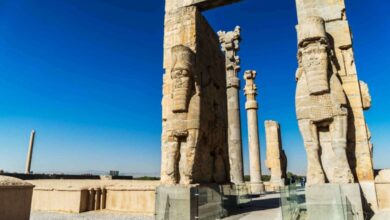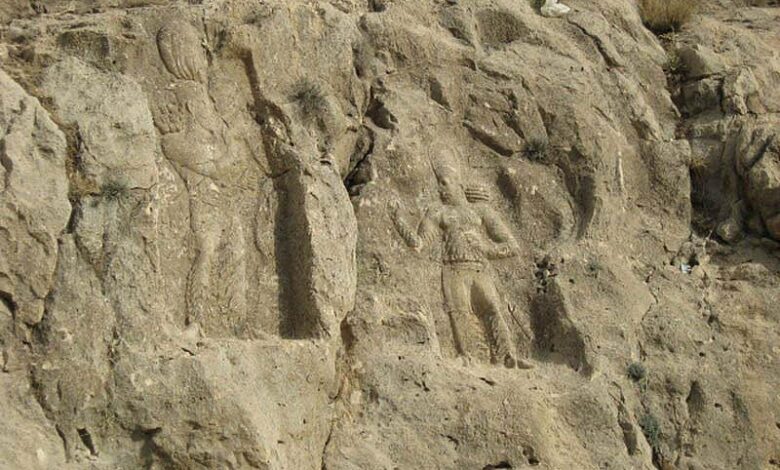
Barm-e Delak, also written Barm-i Dilak, is a Sasanian rock-relief site about 10 km southeast of Shiraz. Two relief compositions, arranged across three carved panels, sit high on a rocky face near a spring. The site is valuable because it preserves royal and courtly imagery from the Sasanian period while also showing how interpretations of ancient reliefs can change as scholarship develops.
Contents
The two Sasanian reliefs
The larger relief measures roughly 1.8 to 2.1 metres high by 2.6 metres wide. It shows a man presenting a flower to a woman. A damaged Middle Persian inscription survives beneath the man’s arm. Scholars have proposed different identities for the figures, so the scene should not be presented as a settled portrait of a particular royal couple.
The second composition occupies two panels separated by a natural fissure in the rock. One figure is identified as the Sasanian king Bahram II. The identity of the dignitary facing him has been debated in scholarship. This uncertainty is part of the site’s archaeological interest rather than a gap that should be filled with a definitive claim.
Why Barm-e Delak matters
Barm-e Delak belongs to the wider concentration of Sasanian rock art in Fars, the dynasty’s historic heartland. European travelers recorded the reliefs from the 17th century onward, and they later became the subject of archaeological and art-historical study. For detailed measurements, early documentation and the history of scholarly interpretations, see the Encyclopaedia Iranica entry on Barm-e Delak.
Planning a visit
The site lies outside central Shiraz and is an archaeological landscape rather than a conventional museum attraction. Conditions, access and local routes can change. Visitors should confirm current access locally, avoid touching or climbing on the reliefs, and treat the rock face and surrounding area as protected cultural heritage.