Behistun Inscription: Darius I, Languages and Visitor Guide
Reading Darius I’s relief and three-language royal account


The Behistun Inscription, also called Bisotun or Bistun, is Darius I’s monumental account of his claim to the Persian throne. Carved high on a limestone cliff in western Iran’s Kermanshah region, it combines a royal relief with texts in Old Persian, Elamite and Babylonian. Its importance lies both in what the king wanted readers to believe and in the part the texts played in deciphering cuneiform.
Contents
The Historical Importance of Behistun Inscription
Darius commissioned the monument in the late sixth century BCE, following his accession and campaigns against rival claimants. UNESCO dates its creation to 521 BCE. The text presents those events from the successful king’s perspective: he asserts that he recovered legitimate royal power and defeated rebellion. Treating it as a royal argument, rather than an impartial chronicle, makes the inscription more informative about how Achaemenid kingship was justified.

Reading the relief
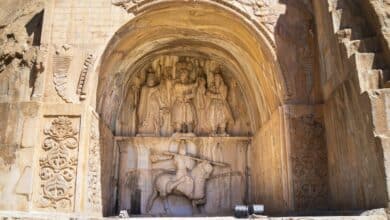
Darius appears with a bow and one foot on a fallen opponent, with captives standing before him. The figure beneath his foot is identified with Gaumata in the king’s account. The arrangement makes a political statement through scale, posture and the contrast between ruler and prisoners. Start by identifying these relationships in a close photograph, then look for the same arrangement on the cliff. It is a rock-cut relief with accompanying writing, rather than a freestanding building.
Linguistic Significance of the Inscription
The three languages gave nineteenth-century scholars related texts to compare. Old Persian, Elamite and Babylonian are distinct languages; the word cuneiform refers to their wedge-shaped writing, not to a single language spoken throughout the empire. Repeated royal names and parallel passages helped researchers test readings. The comparison with the Rosetta Stone concerns the monument’s importance to decipherment, rather than an identity between the scripts or the historical circumstances.

The Inscription as a UNESCO World Heritage Site
Bisotun entered UNESCO’s World Heritage List in 2006. The inscription and relief are the principal monument, but the archaeological setting also preserves evidence from other periods. Its position beside a historic route between the Iranian plateau and Mesopotamia helps explain the choice of location. The monument belongs to a landscape of movement and settlement, rather than an isolated cliff chosen only for its dramatic appearance.
The Role of Behistun in Ancient Persia
Rüdiger Schmitt’s study of the inscription explains how Darius introduces his genealogy and right to rule before describing Gaumata and the revolts. This is useful evidence for royal ideology, but the defeated claimants do not speak for themselves in the text. When a translation calls an opponent a pretender or rebel, ask whose judgement the wording expresses. The distinction preserves the value of the inscription without turning the king’s claims into an unqualified modern account.

Tourism and Accessibility to Behistun Inscription
The relief stands well above the plain, so viewing it is different from reading an inscription at eye level. Binoculars or a camera with an optical zoom can help you recognise the figures. Bring a labelled photograph or translation to connect the distant forms with the text. Use the designated visitor paths; a historic account of scholars climbing the cliff is not a sightseeing route.
How scholars read the inscription
Henry Rawlinson copied the Old Persian text during repeated visits in the 1830s and returned for further work in the 1840s. Peter T. Daniels’ account distinguishes those visits and cautions against simplified stories of a single dramatic descent by rope. Rawlinson’s work was part of a wider scholarly effort, with other researchers contributing to readings and publication. A translation in hand allows a visitor to follow that achievement without needing to recognise individual signs on the rock.

Planning Your Visit
Plan Bisotun as a distinct stop in a Kermanshah itinerary, with time for the wider archaeological setting as well as the main relief. Decide whether your main interest is photography, the royal narrative or the history of writing; a specialist guide can then focus the visit accordingly. The Kermanshah travel guide provides context for combining sites in the region. This article does not assign unverified opening hours or promise access to the cliff face.
BOOK ONLINE
Iran Hotels Online
What to take from the visit
Read Bisotun in three parts: the ruler and captives in the image, the king’s argument in the text, and the multilingual evidence that later scholars learned to interpret. These perspectives explain why the monument matters beyond its scale. They also make a distant view of the cliff more meaningful than a stop for a photograph alone.
Read More
Sources
UNESCO World Heritage Centre. (n.d.). Bisotun; (2006). Decision 30 COM 8B.41. Schmitt, R. (2000; updated 2016). Bisotun iii. Darius’s inscriptions. Daniels, P. T. (2009; updated 2015). Rawlinson ii. Contributions to Assyriology and Iranian studies. Encyclopaedia Iranica. Reviewed 1 November 2026.