Exploring Fin Garden: A Historical Oasis in Kashan
Pools, pavilions and the history of Kashan's Persian garden


Fin Garden in Kashan, Isfahan province, brings pools, channels and pavilions into a formal Persian garden layout. It is one of the nine gardens in The Persian Garden, the serial UNESCO World Heritage property inscribed in 2011. Kashan’s heritage authority records its national listing as number 238 in 1314 SH (1935–36).
The garden has several historical layers. Iran’s national tourism portal attributes its present form to Shah Abbas I, while Encyclopaedia Iranica credits Shah Safi with the original construction and notes earlier royal use of the springs. Later Zand and Qajar additions make a single construction date misleading.
BOOK ONLINE
Kashan Hotels
Water reaches the garden from the Soleymaniyeh spring system behind it. The pools, pavilions and two historic bathhouses belong to the complex. Agha Bozorg Mosque and School is a separate Qajar monument in Kashan, not a building inside Fin Garden.
The garden is also a place of political history. Amir Kabir, the dismissed Qajar prime minister, was exiled here on 3 December 1851 and killed in the small bathhouse on 10 January 1852.
Contents
First Impressions of Fin Garden

Follow the main north–south axis from the entrance building through the central pavilion towards the far end of the garden. A cross-axis links the bathhouse side with Kashan Museum. This arrangement makes the water channels and buildings useful reference points as you explore.
The central pavilion opens towards all four sides of the garden. Look along those views to see how paths, planted areas and water belong to the same design, rather than treating the buildings as isolated monuments.

High walls and towers enclose the garden. Together with its geometric paths, this boundary gives the planted interior a distinct setting within the surrounding city.
Why Water is Essential in Fin Garden, Kashan
Water has several roles here: it irrigates the planted areas, fills reflecting pools and animates channels and fountains. The height difference in the water system supplies the pressure that drives the fountains. Their operation depends on gravity and hydraulic design, not on water rising without a source of energy.
Compare the still surfaces of the pools with the movement of water through channels and fountain jets.
Hoz-e Joosh: the Bubbling Pool

The name Hoz-e Joosh describes bubbling water, not sulphur. Openings in its floor distribute the incoming water.
How the Hoz-e Joosh Water System Works
The Kashan heritage authority describes 160 openings: 80 admit water and 80 take it away. Terracotta pipes carry it towards the Twelve-Fountain Pool. These figures describe the design, not the number of jets working during a visit.
The Twelve-Fountain Pool

The Twelve-Fountain Pool forms a long water feature in front of the royal sitting room. Iranica records an additional pool with small fountains under Mohammad Shah Qajar. The national tourism portal explains the garden’s fountain system through differences in water level, rather than an absence of physical force.
Fin Bathhouse

The complex contains two historic bathhouses, generally distinguished as the smaller Safavid bath and the larger Qajar bath. Their position beside the garden’s cross-axis helps explain why the baths and the museum can be explored as separate parts of the same complex. The smaller bath is associated with Amir Kabir’s death.
Safavid Pavilion

The Safavid Pavilion is the garden’s central viewing point. Its open-sided design connects the interior with the surrounding garden, and a reflecting pool and entrance path form the main approach. Iranica describes a two-storey pavilion and a later upper extension that no longer survives.
The Shah Neshin Room

The Shah Neshin is a covered reception hall with smaller flanking rooms, or goshvareh. Kashan’s heritage authority identifies it as a Qajar addition. Five openings face the courtyard, giving it the name panj-dari, or five-door room; its vertically sliding windows also explain the name orosi. The Hoz-e Joosh and Twelve-Fountain Pool form the water display in front of the hall.
The Tea House

Cheshmeh Zananeh, or Women’s Spring, was a water-distribution area. Kashan’s heritage authority says more than a third of the spring water entered it before underground channels fed the Safavid pavilion, Qajar pavilion and Hoz-e Joosh.
Qajar Pavilion or Fath-Ali Shah’s Camel-Neck Pavilion

The Qajar pavilion, also called Sofeh Fath-Ali Shahi, belongs to Fath-Ali Shah’s programme of repair and expansion. Iranica dates its completion to 1811 from an inscribed chronogram. A turquoise-tiled pool and fountains occupy the pavilion, whose vaulted ceilings were decorated with portraits of the shah and Qajar princes.
The Karim Khani Nook

The Karim Khani Nook is a Zand-period addition on the garden’s southwest side. Its small courtyard has interconnected rooms along two sides. The heritage authority describes entrances from both the garden and the public passage, showing how this more private suite relates to the main enclosure.
The National Museum of Kashan

The National Museum of Kashan occupies part of the former Nizam al-Dowleh retreat on the garden’s west side. According to Kashan’s heritage authority, local figures from Kashan and Natanz formed a preservation association and planned the museum in 1337 SH (1958–59). It opened in 1346 SH (1967–68) with support from people interested in the region’s culture and art. Its location connects the modern museum with the earlier Qajar residential extension.
Access to Fin Garden, Kashan
- Visiting hours: The garden is open every day except for Tasu’a and Ashura of Hussein, the 21st of Ramadan (martyrdom of Imam Ali), the 28th of Safar (demise of the Prophet), the 14th of Khordad (demise of Imam Khomeini), and the 25th of Shawwal (martyrdom of Imam Jafar Sadiq).
- Published hours: The heritage office’s Fin page gives 09:00–17:00, while its general FAQ gives 09:00–17:30. Both refer to the first six Solar Hijri months. Neither supplies a confirmed winter timetable.
Important Historical Events that Occurred in Fin Garden!
Fin’s royal history spans several dynasties. Some episodes concern the garden itself, while others belong to the wider history of Kashan and its visiting court. Keeping those locations distinct helps explain the site without turning every local royal event into an event inside its walls.
The Celebration of Shah Isma’il Safavi
Encyclopaedia Iranica records a royal audience given by Shah Ismail I at Fin. This places the springs and their surroundings in Safavid court history before the later garden buildings took their present form. Royal use of the area should not be read as a construction date for every surviving pavilion.
The Murder of Khizr Neyavandi, the Ruler of Kashan
Khizr Neyavandi was for years the sole ruler of Kashan, wielding great power and influence to the extent that Shah Abbas Safavi became concerned about his power. Around the year 986 Hijri Shamsi, while Khizr Neyavandi was walking in Fin Garden, someone attacked and stabbed him to death. It was later said and written that this event was a political assassination ordered by the Shah.

Shah Safi and the Succession of 1642
Shah Safi died in 1642, and his son succeeded him as Abbas II. Rudi Matthee’s account in Iranica places the young shah’s enthronement in Kashan on 15 May 1642, at the age of nine and a half. It locates the ceremony in the city without identifying Fin Garden as its precise venue.
The Assassination of Amir Kabir
Amir Kabir served as Naser al-Din Shah’s chief minister from 1848 to 1851. Hamid Algar’s Iranica biography describes reforms to state finances, including salary and stipend reductions, and military training with Italian and Austrian instructors. His public works included completing a canal from Karaj to improve Tehran’s water supply. He also founded Dar al-Fonun in Tehran to train officers and civil servants; its teaching extended to medicine, mathematics and natural sciences.
Naser al-Din Shah dismissed Amir Kabir as chief minister on 16 November 1851 and stripped him of his remaining offices five days later. His removal preceded the confinement at Fin and his death in the small bathhouse. This sequence explains why the bathhouse is associated with the fall of a minister as well as with the history of royal leisure.
Amenities and Recreational Facilities

Fin Garden in Kashan offers a range of amenities for the comfort and enjoyment of its visitors. These include restrooms, a parking lot, a prayer room, a teahouse, a store selling cultural products and souvenirs, and a restaurant within the historical complex.
A combined outing can include Fin and Tepe Sialk. Xavier de Planhol’s historical geography places Sialk between Fin and the city of Kashan. Treat this as an outing with separate stops, rather than assuming all the sights form one short walk. The Tabatabaei House, Agha Bozorg Mosque and Sultan Amir Ahmad Bathhouse can form another group of stops in the historic city.
Best Time to Visit Fin Garden

The Kashan heritage office’s seasonal advice recommends Farvardin to Khordad, the first three Solar Hijri months, plus Mehr and Esfand. These correspond roughly to late March through late June, late September through late October, and late February through late March. Use these as seasonal planning windows for the city and its Persian gardens, rather than treating the whole summer as an equally comfortable walking season.
Habibollah Zanjani’s geography of Kashan describes a warm city beside the Central Desert, with a large seasonal temperature range and most precipitation in winter and spring. Shade and moving water are central to Fin’s design, but an outdoor garden visit still needs clothing and a pace suited to the day’s weather. Regional rosewater production is associated particularly with Qamsar; it is a separate reason to explore the wider Kashan area.
Where is Fin Garden Located?
Address: Fin Garden historical complex, at the end of Amir Kabir Street, Kashan, Isfahan province.
The heritage authority lists the garden telephone as 031 5530 2010, or +98 31 5530 2010 from abroad.
Book Kashan Hotels
How to Access Fin Garden?
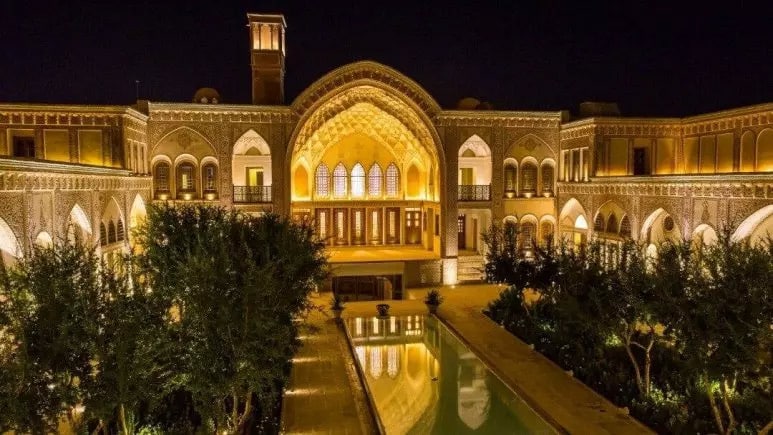
The garden entrance is at the end of Amir Kabir Street in the southwest of Kashan. Use Fin Garden itself as the destination when planning the outward journey, rather than the bazaar or one of the historic houses in the centre.
For an itinerary that includes Fin, Sialk and the historic centre, allow time between the separate stops. A private transfer or taxi can be a planning option for the outward trip, but this guide does not establish a current bus route, stop or timetable. Choose the transport arrangement before setting out, especially if you need a return journey at a particular time.
Sources for the Revised Sections
UNESCO World Heritage Centre. (n.d.). The Persian Garden. Saidi Sirjani, A. A. (1988, updated 2016). Bāḡ-e Fīn. Encyclopaedia Iranica. Visit Iran. (n.d.). Fin Garden of Kashan. Kashan Cultural Heritage, Tourism and Handicrafts Department. (n.d.). Fin Garden World Heritage Complex. Visit Iran. (n.d.). Agha Bozorg School and Mosque. Matthee, R. (2014, updated 2018). ʿAbbās II. Algar, H. (1989, updated 2018). Amīr Kabīr, Mīrzā Taqī Khan. Encyclopaedia Iranica. Zanjani, H. (2012, updated 2017). Kashan i. Geography. De Planhol, X. (2012, updated 2017). Kashan ii. Historical geography. Encyclopaedia Iranica. Kashan Cultural Heritage, Tourism and Handicrafts Department. (n.d.). Frequently asked questions. Sources reviewed on 2 November 2026 for the revised history, layout, water system and contact details.



Though I dont have financial resources at the moment to visit this great country, I have always admired its culture, traditions and history. Reading this piece of writing has ignited my interest in Persian history. Just imagine a garden standing since antiquity, and what it has witnessed, the great men who have walked its gardens, influential and momentous meetings that have changed the course of world history, all in this great garden!!! If history is to teach us, is that we are all a moment’s breath in the great scheme of things, and history will remain, to teach the coming generations of what has been achieved by us- and this garden is a testament to the great legacy of the Persian culture
Thank you for sharing